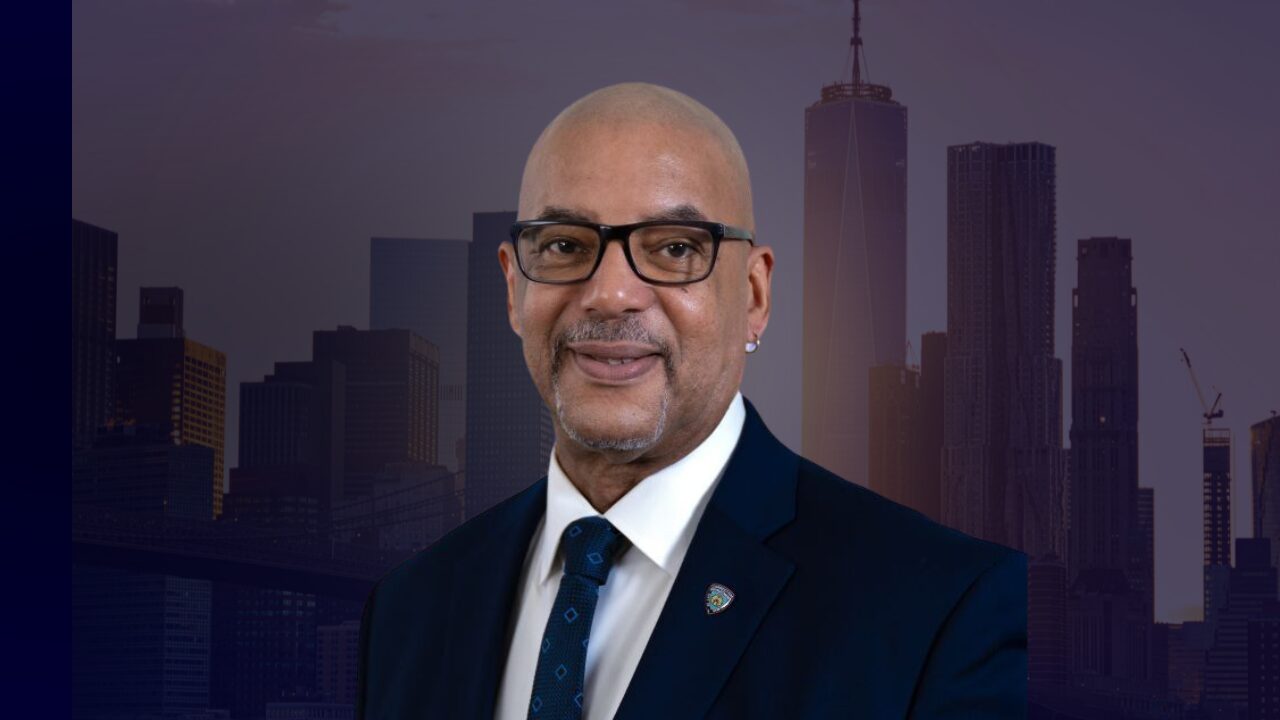
REFORM in Focus: Commissioner Stanley Richards on Supervision Reform and Reentry Support

Welcome to REFORM in Focus, our thought leadership series that spotlights innovators reimagining probation, parole, and public safety. Each edition features experts who are driving meaningful change to our supervision system.

When Commissioner Stanley Richards discusses criminal justice issues, he speaks with rare authority. He has seen the system from within, having served time in prison over 30 years ago. For the past several decades, Richards has been working to transform the system into one that recognizes human dignity at all levels. Today, he is the Commissioner of the New York Department of Correction, and is the first formerly incarcerated person to serve in that role. On June 17, he will join REFORM at our New York office for the latest installment of our Speaker Series.
In advance of that event, we sat down with Commissioner Richards to talk about his life, career, and justice philosophy.
Commissioner Richards, you’ve experienced the system from multiple vantage points. You’re someone who was formerly incarcerated, then worked as a reentry counselor, nonprofit leader, and now Commissioner of the New York City Department of Correction. How has that journey shaped the way you think about accountability, criminal justice, and public safety?
I think about my journey in terms of preparing me for this very moment. There were times in my life where I had no hope, where I was caught in the cycle of the system, where I learned to live in that system. Then I found my way out and my footing to build a life post-incarceration.
When I was released in 1991, I became a reentry service provider at the Fortune Society and rose through the ranks to become a managing director and executive, eventually leading to running the Fortune Society as the president and CEO.
All of the appointments I’ve experienced have really prepared me for this: being the first formerly incarcerated person, being on the Board of Correction, becoming the first formerly incarcerated Deputy Commissioner in the middle of Covid, and then coming back as Commissioner.
My life has given me a 3D understanding of what it takes to sit in this seat: understanding the community, understanding the challenges faced by people in our care, and understanding the complexity of the role correction officers play today. This is an exciting moment for me to be part of this movement of hope and possibility.
Do you think there’s something policymakers or the public still don’t fully understand about people coming home from incarceration and the support they need?
In this country, we’ve leaned very heavily on punishment. Not just for the initial offense, but through a system of perpetual punishment that follows people long after they come home from jail or prison. Because punishment is so central to the system, people involved in the criminal legal system are often demonized, which then allows society to keep them isolated and not provide the resources people need to build new lives.
It’s a complex issue. The people in our care are complex, just like family members, friends, and community members. It takes sustained effort, financial investment, and an all-of-government, all-of-community approach.
Look at systems in Germany and other parts of Europe, where corrections are built around three core principles. The first is human dignity for everybody. You don’t lose it when you go to jail and you don’t lose it when you go to prison.
The second is normalization. In other words, the punishment is the removal from the community, not the conditions of confinement. The institution’s responsibility is to create conditions that help people successfully return home and avoid coming back.
And the third principle is that reentry starts on day one. They don’t wait until someone is nearing release. They begin immediately by asking: What does this person need? Housing? Substance use treatment? Mental health support? What resources will help them succeed? We haven’t embraced that approach in this country, and it remains a major challenge. You look at the numbers: nearly two million people incarcerated in our prisons. And we haven’t moved the needle. Or should I say, we’ve moved it just a little bit.
At REFORM, we focus a lot on the nearly four million people under probation or parole supervision. I’m curious about your thoughts on supervision systems—where they work well, and where they become counterproductive.
Supervision becomes counterproductive when it operates as an extension of incarceration rather than as support.
Personally, I prefer the term “reentry support.” If we are truly committed to helping people build new lives, then parole and probation should focus on connecting people to the services and resources they need to succeed. Right now, supervision often begins with a long list of restrictions: Don’t do this. Don’t do that. You can’t go here. You can’t do this.
But imagine if the approach instead began with: What do you need to succeed? How can I support your transition home?
That’s a completely different model, and it’s the one we need.
Our founding story at REFORM is deeply tied to the incarceration of Meek Mill for a technical probation violation. For so many people, supervision becomes a trap door back to prison for non-criminal behavior. Why do these systems rely so heavily on punishment for technical violations, and what would a better approach look like?
A better approach is exactly what REFORM has been advocating for. Supervision should not be a pathway back to prison. It should be a pathway toward stability, success, and ultimately early discharge from supervision. We have a system now that treats everyone the same, even though people have very different needs.
What we need is a more individualized approach. Some people may require more support. Others may require less. But the goal should always be helping people successfully transition into the lives they want for themselves. We need a system that is nuanced, supportive, and focused on successful reintegration, so that people can live the life that they envision for themselves.
What kind of work can be done on the corrections side? You mentioned earlier that reentry work should begin the moment someone enters jail or prison. What does that look like in practice?
I think it’s about using a continuum-of-care model.
We may not decide who comes into our custody, but once someone is in our care, we have an obligation to provide access to the services and resources they need. Eventually, most people are going home.
In New York City, about 85 percent of people in our care are detainees. Regardless of how their cases are resolved, we should be using that time to connect them with housing support, healthcare, mental health treatment, substance use treatment, and community organizations. That’s why we’ve reengaged service providers like The Fortune Society, The Osborne Association, and others to work directly with people inside our facilities.
The goal is that when someone returns home, they already know where to go and who to call for support. And that’s what we’ve built out, and we’re continuing to build out and refine as we build toward the future.
What role do judges, parole officers, corrections leaders, and others throughout the system play in creating pathways toward stability rather than cycles of incarceration?
Right now, the system is fragmented. Prosecutors, courts, jails, prisons, probation, parole—they each tend to operate in isolation. But we should think of ourselves as part of a larger village. Every decision point impacts the next part of the system and impacts the individual moving through it.
So one of the things that I’ve been doing since becoming Commissioner has been to invite our district attorneys, their staff, and the judges to come see how we operate. I want them to understand what happens when someone is given bail or is sent to our care—what they’re coming into, how they experience it, and what we’re trying to do. That helps everyone understand that every decision point within that system impacts the next part of the system and impacts the individual.
That’s what public safety really is: creating the conditions for thriving individuals, thriving families, and thriving communities.
Sometimes when people hear the phrase “criminal justice reform,” they assume it means lowering standards for accountability. How do you respond to that?
I was part of the Independent Commission on New York City Criminal Justice and Incarceration Reform, and in one of our reports we interviewed survivors of crime about what they wanted most. Of course, they wanted closure and procedural justice. But many also said something deeply important: they did not want anyone else to experience the same harm they experienced.
They wanted the people responsible to get the help and support they needed so that future harm could be prevented. That, to me, is accountability. Accountability and public safety are not in conflict with dignity, support, and rehabilitation. In many ways, they depend on them.
You’ve spent years in advocacy and nonprofit leadership, and now you oversee one of the largest jail systems in the country. How is leadership inside government different from leadership outside of it?
I bring all of myself into this role. I bring the lessons I learned as a formerly incarcerated person. I bring what I learned in nonprofit leadership. And I bring the belief that everything starts with people first. That means valuing our staff. It means supporting the people in our care. It means creating a continuum of care beginning on day one. It means diverting people with mental health or substance use needs into more appropriate settings whenever possible. And it means making our facilities safer, for both staff and the people in our care.
At the center of all of this is human dignity. Human dignity for everyone.
Looking ahead a few years from now, what would success look like for you?
Success would mean that the department is operating on principles of humanity and dignity at every level. Not because of who happens to be Commissioner, but because those values are embedded into the institution itself. I want officers to feel supported and valued. I want families to know their loved ones are safe. I want people leaving our care to have real opportunities to build new lives. If those principles become part of the department’s DNA long after I leave this seat, then I’d look back and say, “Job well done.”
That’s beautiful. Now I know you’re getting ready to join us for our Speaker Series. Can you talk about how you connected with us? Are you excited for this event?
I’ve always been an admirer of REFORM. I was there at John Jay when the organization was launched. I’ve always thought that, with this work, there can never be enough of us speaking about the trauma for staff, for people who come into contact with it, and their family members and communities. And I’ve always admired and appreciated REFORM’s strategy and approach.
So I’m really excited to be able to have this conversation. I go way back with REFORM and I see you as a partner in this work.